U.S. flag

An official website of the United States government

Here’s how you know

Dot gov

Official websites use .gov
A .gov website belongs to an official government organization in the United States.

HTTPS

Secure .gov websites use HTTPS
A lock (LockA locked padlock) or https:// means you’ve safely connected to the .gov website. Share sensitive information only on official, secure websites.

    • Environmental Topics
    • Air
    • Bed Bugs
    • Chemicals, Toxics, and Pesticide
    • Emergency Response
    • Environmental Information by Location
    • Health
    • Land, Waste, and Cleanup
    • Lead
    • Mold
    • Radon
    • Research
    • Science Topics
    • Water Topics
    • A-Z Topic Index
    • Laws & Regulations
    • By Business Sector
    • By Topic
    • Compliance
    • Enforcement
    • Guidance
    • Laws and Executive Orders
    • Regulations
    • Report a Violation
    • Environmental Violations
    • Fraud, Waste or Abuse
    • About EPA
    • Our Mission and What We Do
    • Headquarters Offices
    • Regional Offices
    • Labs and Research Centers
    • Planning, Budget, and Results
    • Organization Chart
    • EPA History

Breadcrumb

  1. Home
  2. Circular Economy

National Strategy to Prevent Plastic Pollution

Note: This strategy is under review to determine how it aligns with the current Administration's priorities and to identify the future direction of this work.

The "National Strategy to Prevent Plastic Pollution" provides an approach to reducing and recovering plastics and other materials, as well as preventing plastic pollution from harming human health and the environment.
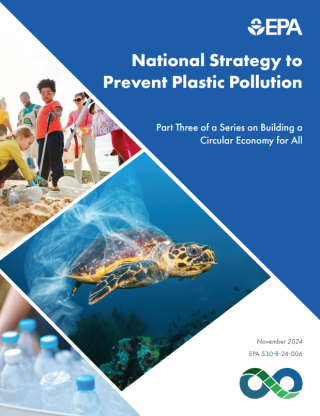
Cover of EPA's "National Strategy to Prevent Plastic Pollution." White text on blue background with images of children picking up plastic on a beach, a sea turtle caught in a net, and plastic bottles.

For decades, EPA has worked to protect human health and the environment from air and water pollution and mismanagement of solid and hazardous waste created throughout the materials lifecycle. Congress recognized the need to take further action to address plastic pollution and passed the Save Our Seas 2.0 Act in December 2020. The Act directed EPA to develop a national strategy on plastic pollution, which EPA published in 2024.

  • National Strategy to Prevent Plastic Pollution (pdf) (13.92 MB) .
  • Executive Summary.

Draft National Strategy to Prevent Plastic Pollution

In April 2023, EPA published the "Draft National Strategy to Prevent Plastic Pollution" for public comment. You can visit the docket to view the draft strategy, executive summary, submitted comments, and other public comment information.

Circular Economy

  • Circular Economy Basics
  • National Recycling Strategy
  • National Strategy for Reducing Food Loss and Waste and Recycling Organics
  • National Strategy to Prevent Plastic Pollution
  • Funding Infrastructure Improvements
    • Recycling Education and Outreach Grant Program
    • Solid Waste Infrastructure for Recycling Grant Program
      • SWIFR Grants for Political Subdivisions
      • SWIFR Grants for States and Territories
      • SWIFR Grants for Tribes and Intertribal Consortia
    • Recycling Grant Selectees and Recipients
  • Sustainable Management of Electronics and Batteries
  • Reduce, Reuse, Recycle
  • Recycling Toolkit
  • Sustainable Materials Management
Contact Us About Circular Economy
Contact Us About Circular Economy to ask a question, provide feedback, or report a problem.
Last updated on June 23, 2026
  • Assistance
  • Spanish
  • Arabic
  • Chinese (simplified)
  • Chinese (traditional)
  • French
  • Haitian Creole
  • Korean
  • Portuguese
  • Russian
  • Tagalog
  • Vietnamese
United States Environmental Protection Agency

Discover.

  • Accessibility Statement
  • Budget & Performance
  • Contracting
  • EPA www Web Snapshot
  • Grants
  • No FEAR Act Data
  • Plain Writing
  • Privacy and Security Notice

Connect.

  • Data
  • Inspector General
  • Jobs
  • Newsroom
  • Regulations.gov
  • Subscribe
  • USA.gov
  • White House

Ask.

  • Contact EPA
  • EPA Disclaimers
  • Hotlines
  • FOIA Requests
  • Frequent Questions
  • Site Feedback

Follow.